Best business cards for startups with no personal credit check

- Business cards with no personal credit check (and soft-inquiry alternatives)
- How do cards without a personal credit check work?
- How to choose the right business card with no credit check
- How to apply for a business card without a personal credit check
- Can you apply with just an EIN?
- Alternatives to no-credit-check business cards
- How Brigit and Seed managed spending as they grew
- Skip the personal credit check and spend smarter

You can qualify for a business card even if your startup hasn't established a credit history. Some business cards don't require a personal credit check. Other cards use a soft inquiry that doesn't affect your personal credit score, but may still involve a review of your credit. You'll still need to meet the provider's eligibility requirements.
Note: The cashback percentages, limits, fees, and other figures mentioned in this article are for illustrative purposes only. They do not represent guaranteed or expected rates. Actual terms, credit limits, rewards, and approval criteria vary by card issuer and may change at any time. Readers should verify current details directly with each issuer before applying.
Business cards with no personal credit check (and soft-inquiry alternatives)
| Card | Personal credit check | Annual fee | Payment structure | Best for |
|---|---|---|---|---|
| Ramp | No personal credit check | $0 | Corporate charge card; full payment under your terms | Funded startups seeking spend controls |
| BILL Divvy | Soft inquiry during initial application; personal report use unconfirmed | $0 | Corporate charge card | Businesses seeking budget tools |
| Capital on Tap | Soft pull when applying; may obtain a personal credit report | $0 | Revolving business credit card | Small businesses seeking revolving credit |
| OpenSky Secured Visa (personal card) | No credit check to apply | $35 | Secured personal credit card | Founders building personal credit with a deposit |
The product information and rewards structures described below reflect issuer-published details at the time of writing. Terms, features, and eligibility criteria may change. Always verify current information directly with each issuer before applying.
Ramp Business Credit Card

- Higher credit limits: Ramp offers credit limits up to higher than traditional business credit cards. That’s because Ramp bases your credit limit on factors like revenue and dollars raised rather than just your business credit score.
- Flexible ways to qualify: Ramp uses connections to some of the biggest commerce platforms in the industry, including Stripe, Shopify, and Amazon, to underwrite credit limits for startups using their sales data. Your business only needs a year of sales history on commerce platforms to be evaluated, allowing you to unlock growth for your startup faster.
- Exclusive partner rewards: Ramp cardholders can access over $350K in rewards from a massive list of partners. Get exclusive discounts, credits, and other perks for business essentials like UPS, AWS, and QuickBooks, plus SaaS providers like OpenAI, Notion, and more.
- Simpler spend control: Enforce your company expense policy with custom spend controls. Ramp lets you set vendor, category, and transaction limits at the individual card level and automatically flags any suspicious or out-of-policy spending.
- More than just a business credit card: When you qualify for Ramp’s business credit card, you get access to a full suite of finance tools. Advanced expense management features, financial reporting, accounting integrations, corporate travel booking, and accounts payable automation are all part of the package.
- Eligibility: Only available to corporations, LLCs, or LPs; sole proprietors are ineligible
- Cash on hand: U.S. applicants must have $25,000 in a business bank account
- Balance transfers: Balance transfers are not supported
Best for: Funded startups and growing companies that want a corporate charge card with built-in expense management and no personal credit check
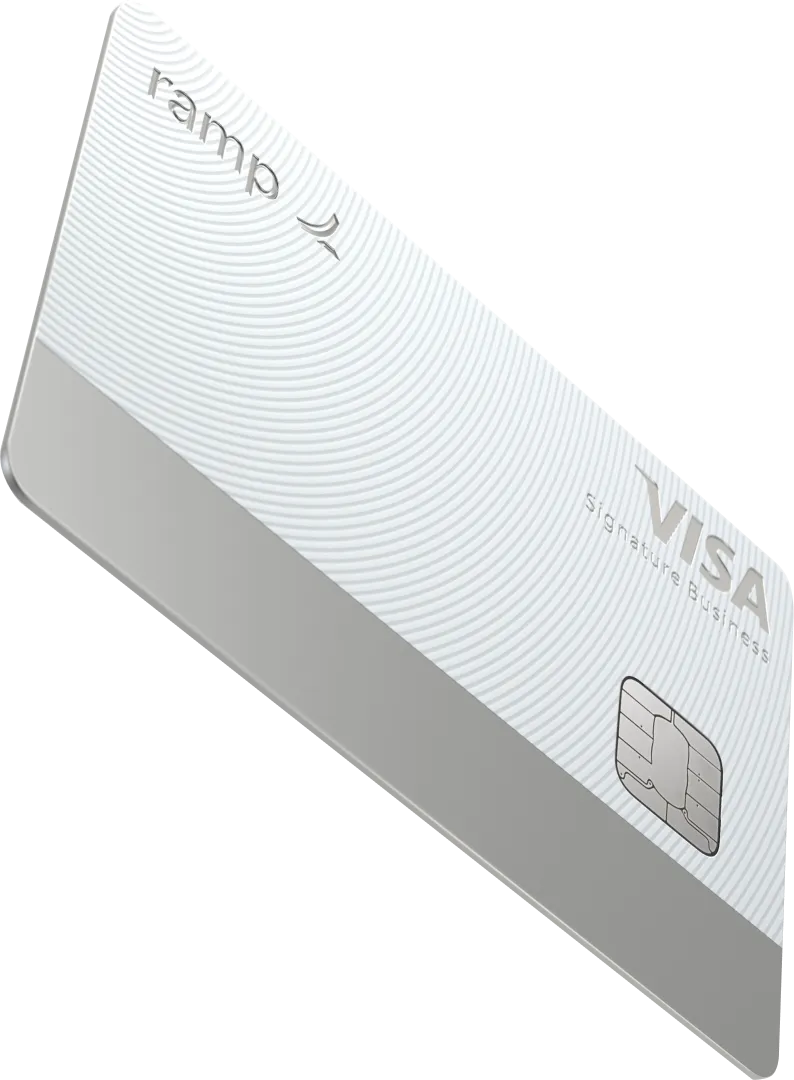
Ramp's corporate charge card for startups stands out for founders who want spending power without sacrificing control. Ramp requires no personal credit check and no personal guarantee. U.S. applicants need an eligible business entity, an EIN, and at least $25,000 in a business bank account, among other requirements.
Beyond unlimited virtual and physical cards, Ramp offers advanced spending controls at the employee or vendor level, real-time alerts, and daily limits to prevent overspending.
The platform automates receipt capture, matches transactions, and integrates with major accounting tools, including QuickBooks and Xero. Ramp also includes corporate travel booking, policy enforcement, and AI-generated insights to flag savings opportunities. Ramp offers cashback rewards on purchases.
Ramp evaluates your business's financial health, including bank balance and revenue, rather than personal credit. Funded startups and venture-backed companies may qualify if they meet Ramp's requirements. Eligible Canadian businesses can apply under separate Canadian requirements.
BILL Divvy Corporate Card

- No personal guarantee: Approval does not require a personal guarantee
- Rewards program: Earn points on eligible purchases through a points-based rewards system
- Expense management tools: Features built-in tools for tracking expenses and managing budgets
- No annual fee: Access the card without paying an annual fee
- Eligibility: Requires a registered business, an EIN, and a U.S. business bank account
- Card type: Operates as a charge card, requiring full payment each billing cycle
- Redemption delay: Points can be redeemed after the initial 12-month period, once you've earned at least 5,000 points and meet other program requirements.
Best for: Businesses that want budgeting tools and an application that won't affect their credit score
BILL Divvy evaluates business financials to determine eligibility. BILL says it uses a soft credit inquiry during the initial application, which doesn't affect your personal credit score. Confirm whether the inquiry uses your personal credit report and ask about any later checks before applying.
Divvy provides both physical and virtual cards with customizable spend controls, enabling you to set budgets by team, department, or project. The integrated expense management software automates receipt capture and categorization.
Capital on Tap Business Credit Card

- Simple 1.5% cashback on all purchases
- Boosted 2% cashback when you switch to weekly balance autopay
- Quick online application; decision times vary
- No annual or foreign transaction fees
- Up to $50k credit limit
- APR can be extremely high. The average rate offered was 46.15% from July through September 2026.
- Fewer business perks than larger issuers
- Only for U.S. businesses in certain states registered as an LLC, LLP, or corporation
Best for: Small businesses and LLCs that want a revolving credit line and are willing to provide a personal guarantee
Capital on Tap offers a business credit card designed for small businesses and LLCs. The card provides credit lines up to $50,000, subject to creditworthiness. Capital on Tap says applying requires a soft pull and won't affect your personal credit score. Its application authorization permits it to obtain personal and business credit reports. Confirm what it checks and whether a later inquiry could be a hard pull.
How do cards without a personal credit check work?
A business card without a personal credit check doesn't require the issuer to pull your personal credit report during the application. The issuer may instead evaluate your business's financial health, including bank balance, revenue, or funding history, to determine eligibility and spending limits.
Even without a personal credit check, the issuer evaluates your application. Ask whether it checks business credit, requests personal information for identity verification, or requires a personal guarantee.
Corporate cards vs. secured cards vs. traditional business cards
Corporate charge cards can evaluate your business financials to determine eligibility and set spending limits. Ramp, for instance, doesn't require a personal credit check, personal guarantee, or security deposit. You pay your balance in full according to your payment terms rather than carrying a revolving balance.
Secured business cards require a refundable cash deposit that usually sets your credit limit. Some check personal credit during the application, while others don't. A secured card can help build credit history if the issuer reports your payments to a credit bureau.
Traditional business credit cards often require a personal credit check and a personal guarantee. They can offer revolving credit, meaning you may carry a balance from month to month, typically with interest.
Hard pull vs. soft pull vs. no pull on your credit
A hard pull is a credit inquiry that appears on your credit report and can temporarily lower your score. Some business credit cards use a hard pull during the application process.
A soft pull is a credit check that doesn't affect your credit score. A no-personal-pull approach means the issuer skips the personal credit check. Ask the provider which type of inquiry it uses and whether its policies change after application.
How to choose the right business card with no credit check
If you're a pre-revenue startup with funding or cash reserves, a corporate charge card may be an option even without established business credit. A secured card may be an alternative if you can't qualify for a corporate card, but you'll need cash for the deposit.
Does the issuer check personal credit?
If protecting your personal credit score is your priority, ask whether the issuer uses a hard pull, a soft pull, or no personal credit check. Ramp doesn't require a personal credit check. BILL and Capital on Tap describe soft inquiries during application, which don't affect your personal credit score. Ask each issuer whether it reviews your personal credit report and whether it may check your credit again later.
Even without a personal credit check, you may need to meet financial requirements, such as a minimum bank balance or sales history. A secured card may be a fallback, but it requires a deposit and some issuers still check personal credit.
What fees and interest will you pay?
Compare fees alongside the card's payment schedule. Charge cards like Ramp require full payment under their terms rather than letting you carry a revolving balance. Check the card agreement for applicable fees.
Traditional credit cards can charge interest on revolving balances. Secured cards may also have annual fees, like OpenSky's $35 fee, in addition to the required deposit.
How is your spending limit determined?
Corporate card providers may set limits based on your business's cash position and other financial factors. Some review limits as those factors change, so your limit may increase or decrease.
A secured card's limit is usually based on its deposit. For example, a $1,000 deposit may give you a $1,000 limit, subject to the issuer's terms.
What rewards does the card offer?
If perks are important, look for a provider that balances rewards and financial tools. The bigger benefit of these cards, though, is access and spend control, especially for newer businesses.
Ramp offers cashback rewards on purchases. Compare the rewards and any conditions against the fees, spending controls, and other features your business needs.
What expense management features come with the card?
If you have limited finance staff, you'll benefit from automated receipt matching, real-time spend tracking, and accounting integrations. These features reduce manual bookkeeping and give you visibility into where every dollar goes.
Not all business cards offer these features. They're more common in corporate card platforms like Ramp and BILL Divvy, which bundle expense management into the card product. If you're choosing between a standalone card and a platform, consider how much time you spend on manual expense tracking.
Does the card report to business credit bureaus?
If building business credit is your goal, confirm the card reports to at least one commercial credit bureau before you apply. Not all cards build business credit, and using a card that doesn't report won't strengthen your credit file.
Some cards report to Dun & Bradstreet, Experian Business, and Equifax Business. Others, including some prepaid cards, don't report. OpenSky reports to personal credit bureaus, which can help build personal credit but not a business credit score.
Discover Ramp's corporate card for modern finance
How to apply for a business card without a personal credit check
Getting a no credit check business card is straightforward if you have the right documentation ready. Follow these four steps:
1. Determine your business structure and EIN status
Check whether your business structure is eligible. Some cards accept sole proprietors, while others require a registered entity. If you need an employer identification number (EIN), you can get one from the IRS for free.
Some issuers ask for your EIN, business bank account, and financial records. They may assess cash balance, sales volume, or linked platform accounts. Ask whether the issuer checks personal or business credit and what information it needs to verify your identity.
2. Gather your financial documentation
Some corporate card issuers evaluate your business financials rather than your personal credit. Have the following ready before you apply:
- Bank statements showing your business's cash position
- Revenue documentation (if applicable)
- Funding history (if venture-backed)
- Business registration documents
Some issuers review connected accounts and may set a minimum balance requirement. Others look for consistent sales history to determine eligibility and set your credit limit. Decision times vary.
3. Compare cards and apply
Compare the cards and narrow your choices based on credit check type, fees, rewards, and the features that matter most to your business. Application and decision times vary by provider.
Once approved, you may be able to issue virtual cards and order physical ones. Some providers let you create employee cards with custom spending limits and category restrictions.
4. What to do if you're denied
Getting denied doesn't mean you're out of options. You can:
- Try a different card type: If you were denied for a corporate card, apply for a secured card instead. The requirements are different, and secured cards are backed by your deposit.
- Build up your business bank balance: Corporate cards weigh cash position heavily. Increasing your balance before reapplying can make a difference.
- Check for errors in your business registration: Incorrect or outdated business information can cause rejections. Verify your EIN, business address, and registered agent details.
- Consider alternatives: Vendor credit, microloans, and business lines of credit have different qualification criteria and may be a better fit depending on your situation.
Options for pre-revenue startups
Most no-credit-check business cards require some revenue or cash reserves. If you're pre-revenue, your options are narrower but not nonexistent.
Secured cards can be an option if you can fund the required deposit. For example, OpenSky is a personal secured card that doesn't require a credit check to apply and reports to consumer credit bureaus. Approval isn't guaranteed.
Vendor credit (net 30 accounts) is another option. Suppliers like Uline and Quill offer payment terms, though qualification and credit reporting vary. Ask the provider whether it reports payments to a business credit bureau.
If you've raised capital or have savings in a business bank account, corporate charge cards like Ramp may still work. Ramp evaluates your overall financial picture, including bank balance and funding history, not just revenue. If you have little cash, compare the deposit, qualification requirements, and other trade-offs before choosing an alternative.
Can you apply with just an EIN?
Some business cards evaluate your application using your EIN and business financials rather than relying on your personal credit. An issuer may still request an SSN or other personal identification to verify an owner or officer.
Identity verification, a personal credit check, and a personal guarantee are separate requirements. Check each before applying.
How to build business credit with just an EIN
Building business credit from scratch takes consistent effort, but the process is straightforward:
- Register your business and get an EIN: Register your business under state rules, if required, and apply for an EIN through the IRS.
- Open a business bank account in your company's name: This separates personal and business finances and creates the financial history that corporate card issuers evaluate.
- Get an account that reports to credit bureaus: Ask the issuer whether it reports your account to a business credit bureau, such as Dun & Bradstreet, Experian Business, or Equifax Business.
- Pay balances on time and according to the account's terms: On-time payments can contribute to a business credit history when the provider reports them, though outcomes vary.
- Monitor your business credit reports: Check your Dun & Bradstreet PAYDEX score and Experian Business credit report regularly. These reports show how your payment activity is building your business credit profile.
Building a business credit profile takes time, and reporting practices vary. Consistent on-time payments and responsible credit use are a starting point.
Alternatives to no-credit-check business cards
Vendor credit, microloans, revenue-based financing, and business lines of credit are all viable alternatives if you don't qualify for a no credit check card or need a different funding structure. Each option has its own financing terms, qualification criteria, and tradeoffs.
Vendor credit lines
Vendor credit lets you buy supplies or services and pay later. With net 30 terms, for example, you have 30 days to pay the invoice. Vendors like Uline, Quill, and Summa Office Supplies offer payment terms to eligible businesses.
This can be useful if you make regular purchases from a supplier. Ask whether the vendor reports payments to a business credit bureau, since reporting can help establish a trade credit history. Approval requirements vary and may include a review of your credit or purchase history.
Microloans
Microloans can provide startup funding through nonprofit organizations and community lenders. The SBA Microloan Program offers loans up to $50,000 through intermediary lenders, with repayment terms up to seven years. Other sources include Accion Opportunity Fund and Kiva.
Terms and qualification requirements vary. Be prepared to provide financial documents and a business plan, and check whether the lender requires collateral or a personal guarantee.
Revenue-based financing
Revenue-based financing provides upfront capital with payments tied to future sales. Providers typically review your revenue history, so it may suit an established e-commerce or retail business better than a pre-revenue startup.
Costs and repayment structures vary and can be expensive. Check the total cost and how payments will affect your margins and cash flow.
Secured business cards
A secured business credit card requires a refundable deposit that usually determines your credit limit. For example, a $1,000 deposit may give you a $1,000 limit. You still need to make payments under the card's terms; the deposit isn't a prepaid spending balance.
A secured card may be an option if you can't qualify for unsecured credit, but some issuers still check personal credit. Ask whether the card reports to business or personal credit bureaus if building credit is your goal.
Personal credit cards for business use
Some founders use personal credit cards to cover early business expenses. Mixing personal and business spending can make accounting and tax preparation harder, and you're personally responsible for the card's debt. Check the card's terms before using it for business purchases.
The OpenSky Secured Visa is a personal card that doesn't require a credit check to apply. It requires a refundable deposit and reports to consumer credit bureaus, so it may help you build personal credit, but not necessarily business credit. It may be worth considering if you're building credit from scratch or have bad personal credit, though approval isn't guaranteed.
Business lines of credit
A business line of credit lets you draw funds up to an approved limit and generally pay interest on the amount you use. It can help a business with consistent revenue cover short-term cash-flow gaps.
Lenders may review revenue, bank activity, and credit when determining eligibility. Compare interest, fees, repayment terms, and any personal guarantee requirements.
How Brigit and Seed managed spending as they grew
Brigit is a New York fintech whose app helps millions of people budget, avoid fees, and access interest-free cash advances. Like a lot of early-stage startups, it ran into a wall with traditional lenders. Banks saw a young company as too risky and wouldn't work with them. The corporate card Brigit did have took weeks to set up and capped spending far below what a fast-growing team needed.
Brigit rolled out Ramp in under a week and gained spending controls and an audit trail for purchases and approvals.
Microbial sciences company Seed hit a different version of the same problem: a credit limit that couldn't keep up with growth. Its legacy provider's spend caps were so tight that marketing campaigns kept getting cut off.
"I don't even know the number of times that ads were shut off because of all this," said Controller Sarah Bird.
Ramp matched and exceeded Seed's credit needs without the restrictive caps. As Bird put it, "Ramp was a fast-growing startup itself and they understand how to scale."
Skip the personal credit check and spend smarter
Ramp is a corporate charge card that removes the personal credit check barrier and adds the expense management tools your startup needs. You won't go through a personal credit check. Instead, Ramp evaluates your business's financial health to set your spending limit.
You don't need a personal guarantee. Because Ramp is a charge card, your balance is due in full according to your payment terms rather than revolving with interest.
Ramp offers cashback rewards on purchases, plus built-in expense management that automates work many startups handle manually. Ramp auto-codes 90% of transactions. Real-time spend tracking helps you see where money goes, and integrations with QuickBooks, Xero, and NetSuite keep your books in sync.
For startups, this means fewer hours on expense reports and more time building your product. Pre-spend controls block out-of-policy purchases before they happen, so you don't discover budget overruns at month-end.
Try an interactive demo to see how Ramp simplifies startup spending.
At Ramp, transparency and integrity are core values guiding our content. We believe in the exceptional value of our products, which may shape our perspective. Our methodical approach involves competitor analysis, comparison of credit cards, and frequent reviews to maintain reliability. Review our full methodology for choosing the best business credit cards.

FAQs
Yes. Some corporate charge cards, including Ramp, evaluate business finances without a personal credit check. You'll still need to meet the provider's eligibility requirements.
Some pre-revenue businesses may qualify for a corporate card if they meet the provider's financial requirements, such as having sufficient cash or funding. If that isn't an option, consider a secured card or vendor credit and check the provider's terms.
Some providers use your employer identification number and business finances to evaluate your application. They may still request personal information, including an SSN or other identification, to verify who you are.
It may if the issuer reports your account activity to a business credit bureau. Ask the issuer which accounts it reports and to which bureaus. A personal card that reports to consumer bureaus builds a personal credit history, not necessarily a business one.
Yes. Eligible Canadian businesses can apply without a U.S. entity. Ramp has separate Canadian eligibility requirements, including a minimum balance across connected accounts.


“Our cupcakes are handmade. Our back office doesn’t need to be. Ramp gives us the automation to run a big business without losing the personal touch that made us who we are.”
Amanda Tedeschi
Controller, Baked by Melissa

“I want to trust the people at our sites to buy what they need, when they need it. With everything in Ramp, they have one place to go and one set of rules to follow. And I can see how all of their spending ties back to the contracts that fund their work.”
Marina Peterson
CFO, Wu Yee Children’s Services

“Finance isn’t just there to keep a record of the past. Are we negotiating with a retail partner? We have a seat at that table. Looking at a brand partnership? We have a seat at that table too. That’s really the big unlock: finance can be a strategic partner across the business, while Ramp keeps day-to-day work from pulling us away.”
Rachel Prescott
CFO, Caraway

“I assumed I would have to choose between speed and control. What I found is that you can have both. A well-designed system takes friction out, for the finance function and for everyone else.”
Justin Webster
CFO, Denver Broncos

“A well-run district should not have to choose between getting work done at the school site and keeping control of the dollars behind it. We're not hiring more people to do more jobs, so we have to be smarter about the process. With Ramp, the purchase, the receipt, and the record stay together from the start. ”
Nick Brizeno
Director of Purchasing, San Marcos Unified School District

“In senior living, scale only works if the communities still feel personal. We needed the back office to carry more of the complexity, not the people serving residents. Ramp helped us build that infrastructure, so the experience in the community could stay human.”
Ryan Cole
CFO, Agemark Senior Living

“AI is moving faster than the finance context around it. Prices change, models change, and the value is not always obvious from an invoice. We needed enough detail to know which bets deserved more investment — and which ones did not.”
Greg Cooley
Controller, AngelList

“Invoices, cards, tokens. The categories change but the principle doesn't: know where the money is going, remove the work around it, and make sure the spend is worth it.”
Maciej Mylik. Finance
ElevenLabs
